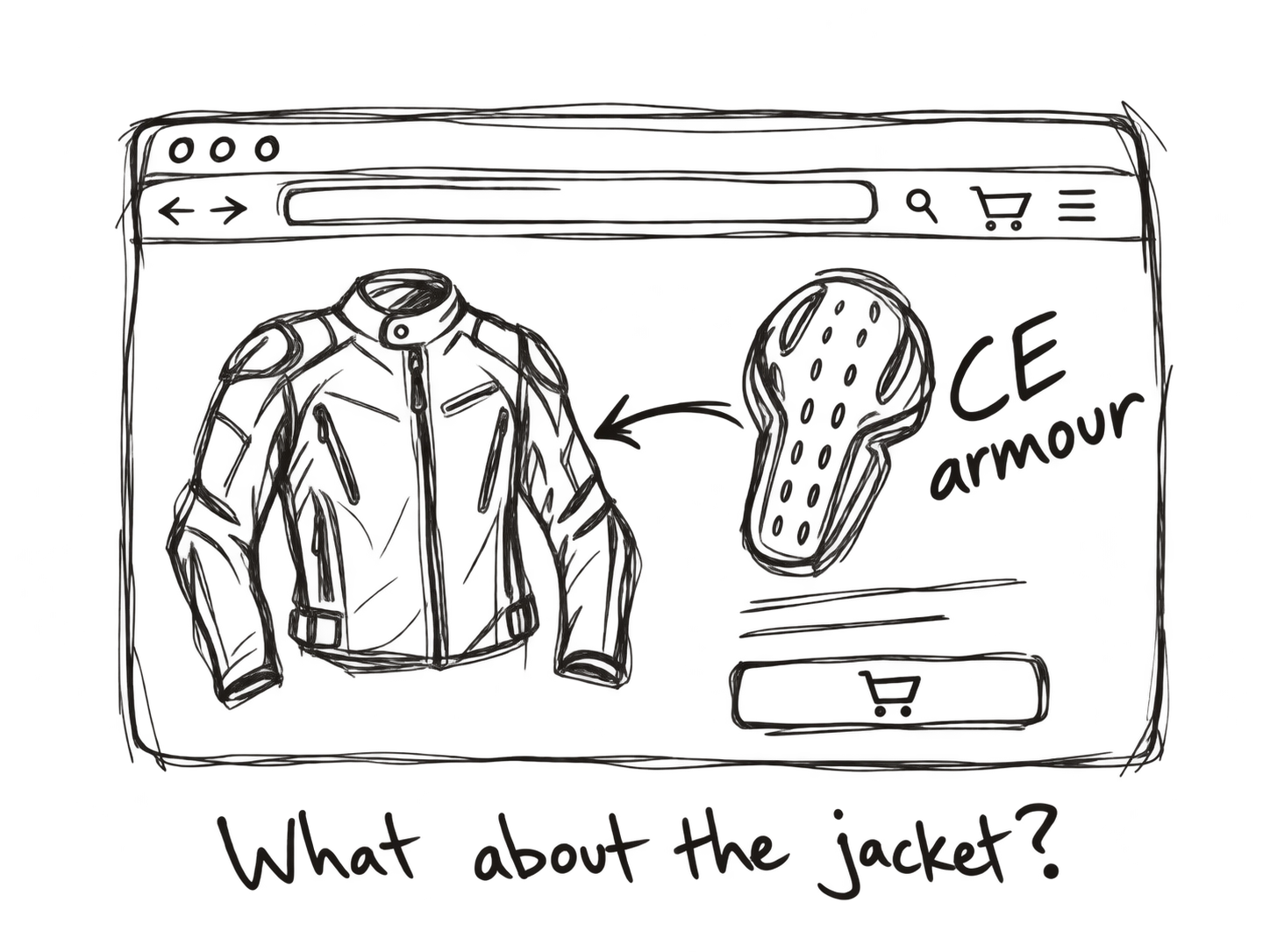
A brand that has not certified its garment cannot write CE next to the garment. So it writes CE rated armour instead.
The armour arrived certified. Somebody else paid for that, tested it, and holds the evidence. The brand adds it to a garment, puts the marking in the product title, and lets the buyer join the two things up on their own. That is the trick. It works, and it is dishonest.
What I did not expect was finding brands doing it who had paid.
I was building the written checks for claim reviews. That means collecting good pages and bad ones until the patterns show up, which looks like browsing and is not.
I went to around ten previous clients. Not at random. I picked them because I put their products through testing and certification myself, so I already knew the certificates existed.
That is harder to establish than it sounds. Publishing the declaration of conformity is a requirement, not a courtesy, but apparently nobody does that any more, so on most pages you cannot tell whether a claim has anything behind it at all. These ones I knew.
At least half were not using what they had paid for, or were describing it so poorly it made no difference. That was their own brand products.
Where they also stocked other brands, those pages read better. Not because more care went into them. Because the description had been copied across from the brand that wrote it. So the worst product copy on the site was the copy for the products they had paid to certify themselves, sitting next to somebody else’s, doing it properly.
I expected the garment standard front and centre. That is the thing they spent the money on. If you cannot mention it at the point somebody is deciding whether to buy, what did you buy it for.
An impact protector reduces impact. It is not there to save your arm.
You come off, you slide, and what is between your skin and the road is the garment. Abrasion, tear, seam strength, all of it in the fabric and the construction. That is the expensive part, that is the part that took six months, and that is the part being left off the page.
There is a second thing wrong with leading on the armour, and it is the part nobody says out loud.
On a certified garment the protectors are part of what was certified. They were assessed in that garment. The pocket holds them in the right place, they stay there rather than working loose in a slide, and the ergonomics were checked with them fitted. That relationship was tested and it sits inside the certificate.
Put CE rated armour on a garment that was never certified and none of that exists. The protector has its own component certificate, which covers the protector tested on its own. Nothing has established that it belongs in that pocket, in that position, on that garment. The claim borrows the confidence of a fitted, verified assembly and none of the work behind it.
Which is also why, on a garment that has been certified, the fitted protectors are not a matter of preference. Change them for something the certificate never covered and you are back to the same gap.
Gloves are worse again, and I saw one this week. There is no certificate for a knuckle protector. There is a report, and a report is not certification, however impressive it looks. That report can be put towards the glove’s certification, and where it is not supplied the knuckle is tested inside the glove instead, with the glove’s materials, sitting where it would sit on your hand. Either way the thing being certified is the glove, and the result comes out as the glove’s level: Level 1 KP, or Level 2 where knuckle protection is required. So CE approved knuckle armour is approving nothing. And the level, which is the real claim and which they may well hold, is nowhere on the page.
I am not a neutral party on this. If I am buying, a page leading on the armour makes me trust the product less, not more.
Certification bodies do not police claims. They assess the documentation in front of them. They are not opening websites to say you should not be leading with the armour. That is not the job, and it was not mine either.
When I was on that side my work finished when the certificate went out. I would sometimes wonder what happened next, and then the next job started, and the one after that, and you stop wondering. If I had taken a product all the way from inception I would go and look at how it ended up being sold, though if I am honest what I was usually looking at was the price.
Trading Standards are a different matter. This kind of claim is the calling card of a brand without a certificate, so leading with it puts a certified brand in the same shape as an uncertified one.
And the page has a second reader now. Buyers paste a product link into an AI tool, or ask the AI assistant built into their browser, whether the jacket is any good. This is normal now.
The AI has the page and nothing else. If the page says CE rated armour, that is the answer it gives back. Level 1 protector. Which tells the buyer nothing, and is what a certified AAA garment gets, because its class was never written down anywhere the AI could find it.
The declaration carries the certificate number, and some certification bodies now run a self-service check on their own website for exactly this. A buyer puts the number in and sees whether it is live.
On a page that has been done properly, most buyers will never need to. Everything they wanted to know is already written down, and the number sits there for the one person who does want to look. On the pages where a buyer has every reason to check, there is nothing to check with.
The technical file has already been through certification and been approved. The brand holds it. Pulling the key materials and the care information out of a document you already own, and putting them on the page, is not a project.
One brand had done the document side properly. Everything published, everything reachable. Then on another product they ran a claim that the garment is not PPE, while selling it with a back bump and protective materials, on a website full of certified motorcycle apparel.
A line saying it is not PPE does not protect you when everything around it says otherwise. The buyer is not going to read that line, and the placement says the opposite of what the sentence says.
The same goes for the claims that get attached out of habit. High abrasion resistant fabric, which means nothing. Waterproof. High visibility, which is the one that gets me, because in ten years of running testing and certification I do not think I ever ran high-visibility reflective testing on a motorcycle garment. The strips on most of them are decoration. Nobody has to test decoration, so nobody pays to, and the claim goes on the page anyway.
What I would want on the page is a brief breakdown of the garment. The style number, so it can be referenced against anything else. What it conforms to, stated plainly and early. The construction. Which protectors are fitted, kept separate from the garment claim. The materials and the care information. Links to the documentation.
Not the technical file. Nobody wants that. Just enough that somebody deciding whether to trust the product can find out what it is.
I will buy the jacket with the full technical description over the one with the badge, every time. The buyer does not have to understand every term on the page. They only have to be able to find out what they are buying, and most pages make that harder than it needs to be.